


If any piece of construction equipment has quietly reinvented its identity over the past few years, it is the tracked mini dumper. Once regarded as a simple labour‑saving device for moving sand and rubble across flat ground, this compact hauler now appears on projects as diverse as luxury pool installations, hillside vineyard terracing, and championship golf‑course bunker renovations-proving that when mobility and surface protection matter most, smaller truly is better.
This year has seen an unusually rich flow of design upgrades aimed at expanding the machine's usable envelope. One of the most talked‑about developments is the introduction of rotating skip mechanisms on mid‑capacity models. Instead of the traditional forward‑tip arrangement, which forces the operator to align the machine precisely with the receiving hopper or skip, the rotating version allows the bucket to turn through 180 degrees or more. This means the driver can stop in a narrow alley, rotate the load to the side, and empty it directly into a waiting wheelbarrow or builder's bag-all without shunting backwards and forwards. For site supervisors managing tight town‑centre projects, this feature has cut unloading cycle times by nearly 40 percent.
Another significant trend is the migration of automotive‑grade ergonomics into this class of equipment. Where older machines relied on basic levers and foot pedals, current models increasingly feature automotive‑style joystick consoles that integrate drive, steer, and tip functions into a single hand control. Some variants now offer proportional fingertip regulation, allowing the operator to feather the dump angle for partial discharges-a useful trick when spreading topsoil or gravel evenly across a prepared bed. Cab designs have also evolved, with some enclosed options offering heating, ventilation, and sound insulation that bring interior noise levels down to around 75 decibels, making all‑day operation far less fatiguing.
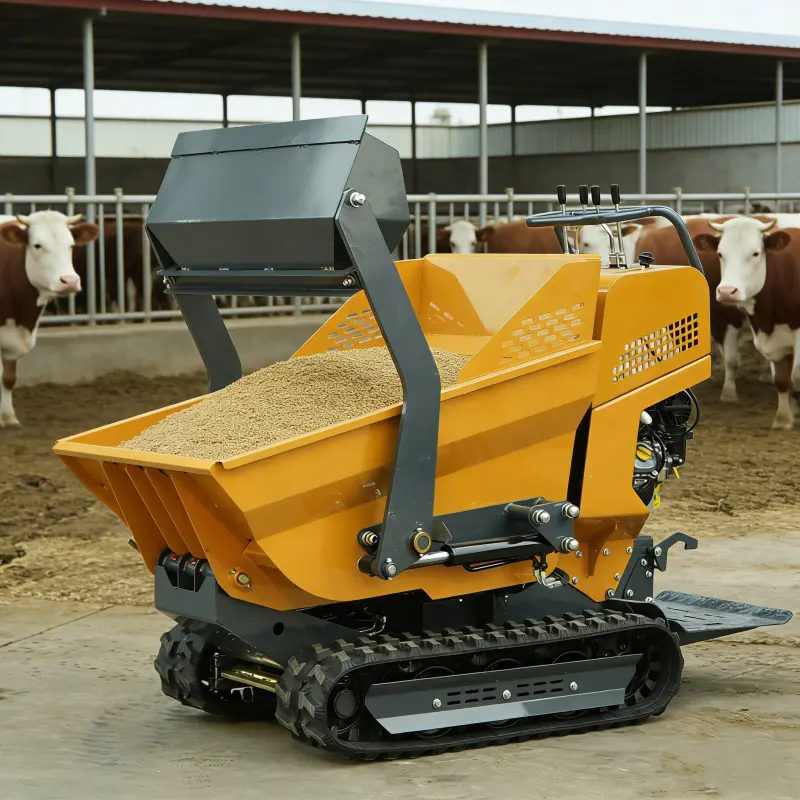
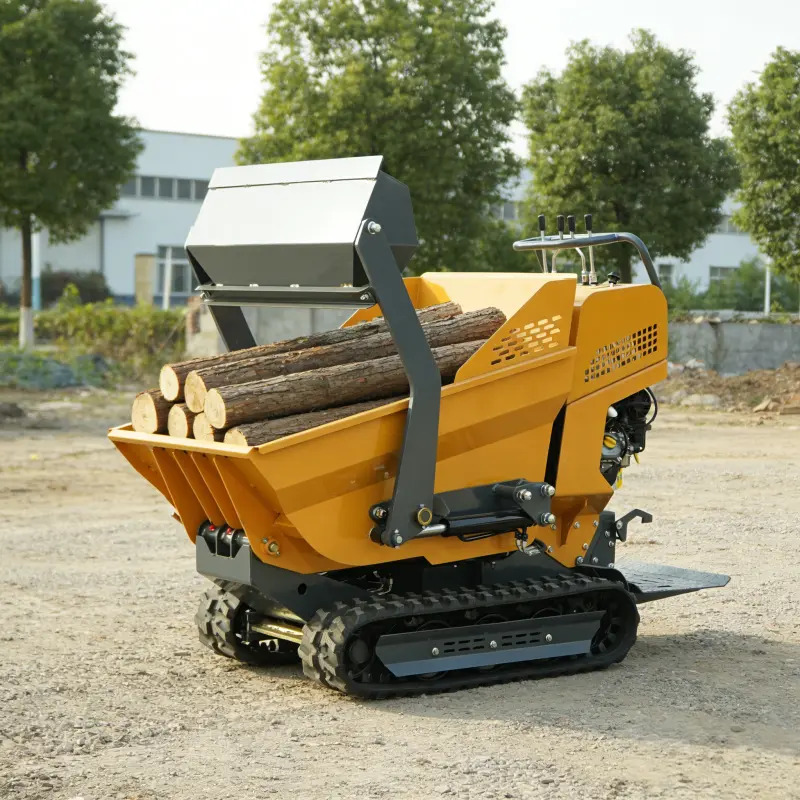
The application list continues to grow in unexpected directions. On large‑scale landscaping projects, such as public park overhauls and botanical garden expansions, contractors are using tracked haulers to ferry heavy stone slabs and root‑balled trees across grassed areas without leaving rut marks. The secret lies in the rubber track system, which distributes weight over a much larger contact patch than pneumatic tyres. In one recent municipal project, a fleet of these machines moved over 200 tonnes of paving material across a pristine lawn over two weeks, and post‑project inspections showed no measurable compaction damage-a result that would have been unthinkable with wheeled equipment.
Agricultural users have also pushed the boundaries. Orchards with steep slopes, once served only by specialised tractor‑mounted carriers, are now turning to low‑centre‑of‑gravity tracked dumpers that can climb grades of up to 20 degrees while carrying half‑tonne loads. The track design provides lateral stability on side‑slopes, reducing rollover risk. Meanwhile, livestock farmers have adopted them for daily feed distribution inside barns, where the narrow width allows passage through standard animal‑access gates, and the quiet electric‑start engines minimise distress to housed animals.
Safety and security features have also received overdue attention. Several new releases incorporate removable ignition isolators and key‑coded start systems to deter unauthorised use-an important consideration as site theft becomes more sophisticated. Automatic braking systems that engage when the operator releases the drive controls are now standard across most mid‑range offerings, preventing unintended roll‑away on inclines. One innovative model even includes a tilt‑sensor that limits tip height when the machine is on uneven ground, reducing the risk of forward‑overload instability.
Trade shows and regional industry exhibitions throughout 2026 have given contractors ample opportunity to test these advancements firsthand. Demonstration areas have been crowded with attendees trying out rotating skips, two‑speed tracking, and adjustable suspension settings. Feedback from these events suggests that buyers are increasingly willing to pay a premium for versatility-they want one machine that can handle muck‑away in the morning, spread gravel after lunch, and transport potted shrubs by late afternoon, all while protecting delicate surfaces.
As the construction calendar moves toward the final quarter of 2026, the tracked mini dumper stands out as a rare piece of equipment that has genuinely expanded its utility without growing in size. Whether threading through a heritage garden gate, climbing a muddy farm track, or operating inside a converted warehouse, these compact carriers have earned their keep-and they are only getting more capable with each new design iteration.