


Stand on any steep hillside in late summer, and you'll see why landscapers have been eyeing remote-control mowers with growing interest. Pushing a walk‑behind up a 30‑degree slope is not just tiring-it's genuinely dangerous. Ride‑ons slip. Robotic mowers get confused by uneven roots and tall weeds. For years, the industry made do with compromises. But the machines arriving in 2026 are different. They don't pretend to drive themselves, and they don't ask you to hold on for dear life. Instead, they put a rugged cutting deck on tracks or fat wheels, hand you a transmitter, and let you work from a safe distance.
The shift is showing up in the numbers. Last year, the global market for remote‑controlled mowers-distinct from the fully autonomous robot variety-sat at roughly $242 million. By 2032, projections put it near $522 million, a steady climb of about 12 percent annually. The broader universe of robotic and remote cutting gear is ballooning even faster, from $9.3 billion in 2025 to an expected $22 billion before the decade is out. Those are not hobbyist figures. Municipalities, solar farm operators, and commercial grounds crews are driving the demand, because they have real problems that simple automation hasn't solved.
Take orchards, for example. Rows of fruit trees leave narrow passages, and the ground is often rutted from irrigation. A conventional tractor can't manoeuvre without knocking branches. A remote‑control tracked mower, however, can pivot on the spot and keep its deck level across the bumps. Solar farms are another unexpected growth area. Panels sit low to the ground, and keeping the vegetation trimmed underneath them has always been a tedious, knee‑crawling job. Now, operators guide slim‑profile mowers beneath the arrays from a hundred metres away, cutting weeds without ever stepping into the shade of the panels. Roadside banks and golf‑course roughs-places where any wheeled machine tends to slide sideways-are also being tamed with machines that grip slopes up to 45 degrees or more.
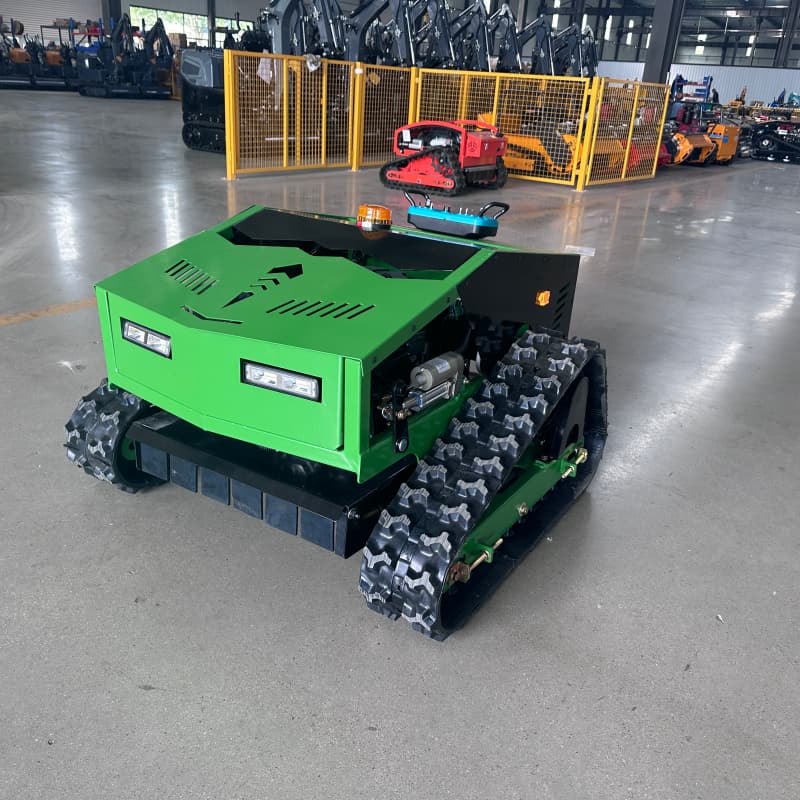
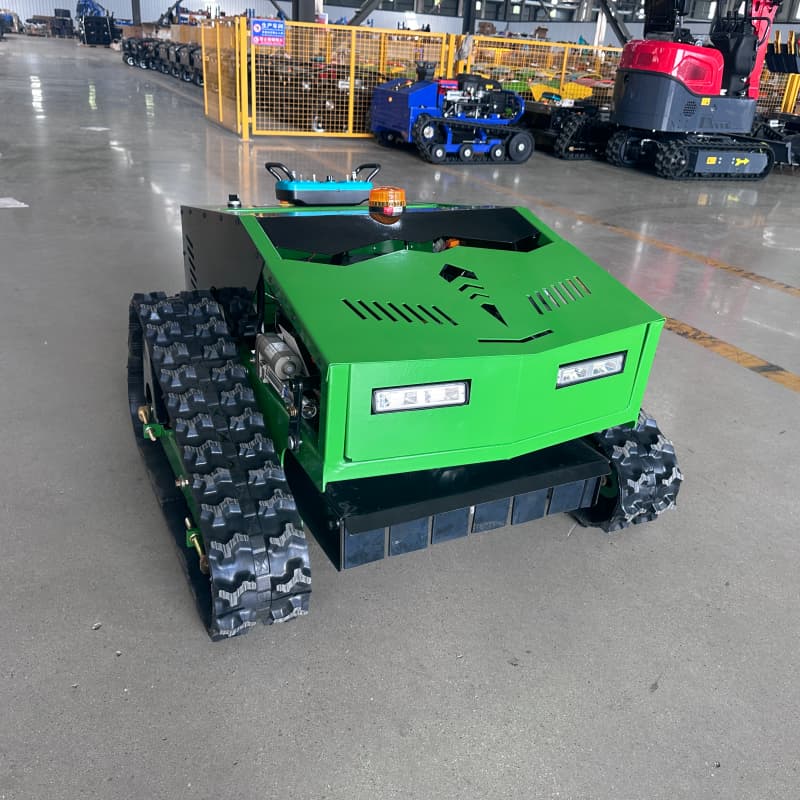
What makes this generation work so much better isn't just the radio link. The real gains are in traction and terrain intelligence. Many new models run on four or six wheels with independent suspension, so each wheel stays planted. Cutting widths range from 50 to over 80 centimetres, and blade speeds adjust automatically to grass density. Battery packs have quietly improved too-lithium‑iron‑phosphate chemistry now delivers two to three hours of solid run‑time per charge, with fast‑charge options that let crews swap batteries during lunch breaks and keep going.
Safety features have evolved from afterthoughts to essentials. Ultrasonic sensors detect obstacles and slow the blades before impact. If the machine tilts past a preset angle, the blades cut off instantly. Emergency stop buttons on the remote override everything else, no questions asked. Some higher‑end transmitters even stream a live camera view from the mower's front, so you can see exactly what's hidden in tall grass before you roll over it. The remote itself used to be a clunky pistol‑grip with a single joystick. Now it's more like a compact game controller with haptic feedback and a small screen-something new operators pick up in minutes rather than hours.
Perhaps the most telling change is how these machines are shedding their "summer‑only" label. Attachment systems are becoming common: clip on a leaf blower for autumn, swap to a light snow blade for winter, or hitch a small trailer to haul debris. One power unit now works year‑round, which makes the upfront cost much easier to justify for parks departments and rural property owners. That modularity is transforming the remote mower from a niche gadget into a genuine multi‑season workhorse.
Regulations are helping, too. Stricter emission rules in North America and Europe are pushing gasoline engines off the market, and battery‑electric mowers are the obvious replacement. Remote‑control models already run on batteries, so they meet the new standards without sacrificing torque or endurance. At the same time, occupational safety guidelines are forcing employers to reduce noise and vibration exposure-two things that disappear when you're not walking behind the machine. The operator sits or stands off‑site, and the mower does the shaking.
None of this means full autonomy is dead. But for uneven, unpredictable terrain, the robotic approach still stumbles over rocks, branches, and sudden grade changes. Remote control keeps a human eye in the loop-the best pattern‑recognition system we have-while moving the person out of harm's way. As batteries get denser, wireless links get more reliable, and attachment options multiply, these machines will likely become as common on commercial fleets as chainsaws and trimmers are today.
They are no longer a curiosity for hobbyists with steep backyards. They are solving expensive, dangerous, and tedious problems every working day. And this year, finally, they're doing it without the fanfare of self‑driving gimmicks-just solid, remote‑guided performance that gets the job done. Quietly. Efficiently. And from a safe distance.